Wednesday, 12 August 2015

#RPGaDay 2015: Day 10 - Publishers

Prompt: Favourite RPG publisher

Okay, this one is where I show my ignorance. I barely think about publishers, so... Well, actually that's not true. I follow Onyx Path's dev blog because I find their open development process interesting, even if I'm unlikely to buy much of their stuff (or any stuff; stoopid penury.) I am also constantly in awe of Fantasy Flight and their ability to add bits to a perfectly ordinary game.

That's all folks, as I'm still behind and I won't be able to write anything this weekend either.

Tuesday, 11 August 2015

#RPGaDay 2015: Day 9 - Off License

Prompt: Favourite media you wish was an RPG
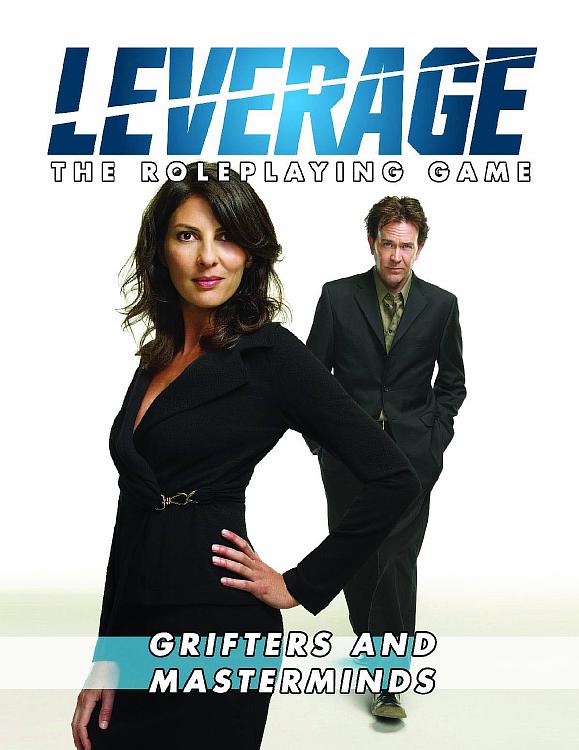
I hear swell things about Leverage, but notably
that is a flagship application of the Cortex Plus
system.

Well, last year I covered most of this in my post about licensed RPGs. I'm not typically sold on licensed RPGs and thus rarely feel that what I really want is for someone to publish an RPG of my favourite media, especially when I could alternatively just hack something under Fate Core or Unisystem, or - although I have less experience of this one - Cortex Plus.

Cortex Plus seems to be pretty much designed for licensed products, with notable releases including Leverage, Marvel Heroic Roleplaying, Smallville and Firefly (not to be confused with the Serenity RPG which was mostly noted for having a character sheet complex enough to make your eyes bleed.) Pretty much all of the above have been well received, but I would still rather have a basic system to play with myself (although I entirely understand the fiscal appeal of the licensed property.) Some day I may pick up the Cortex Plus Hacker's Guide, but I don't actually know if it contains the basics to run from.

-

Fate Core is a lovely system because it's built to be adaptable without additional material. Adapting an existing setting to Fate Core is a three stage process:

1) Define Aspects - By default, Fate Core characters have five Aspects: Their High Concept, their Trouble, and three relating to their background which are defined in concert with the other players (Fate Core is a fundamentally cooperative system.) By changing these categories, you can alter the focus of the game. Perhaps in a supers game, 'Trouble' could be replaced with 'Power Source', an Aspect that defines where your powers come from, and by extension how they can be taken away. In an espionage or heist game, each of the later three Aspects could be a lesson learned in a past gig: 'Never Trust a Dame', 'Don't Get Personal', or 'Always Check Your Exits'. In a more structured horror setting you might have a High Concept, a Dark Secret, a Known Fear, a Secret Fear and a Survival Trait.

For the 80s Cartoon game I hope to run some day, I'd go with something like: High Concept, Focus Flaw (the problem you have when the episode gets to being about you), Meaningful Codename, Weapon and Vehicle/Suit/Totem Animal.

2) Set Skill list and Refresh level - Decide how many and what skills to use. Small skill lists result in more generalist characters; longer ones demand specialists. You then set the Refresh level (starting Fate Points), which can be dropped to buy additional stunts an (if you have them) powers. More Refresh means potentially greater powers and more flexibility; less means specialise and chose your moments carefully.

The Cartoon game is unlikely to need a large skill set, and much is likely to be determine by dramatic twists. I'd go for a short skill list and high Refresh.

3) Determine extras - This is either the biggest or the smallest job, as you could do anything from deciding that, fuck it, you're good with the core system to adding complete magic systems, super powers and other weirdness.

Again, taking the 80s Cartoon example, you'd probably need something tailored around the vehicles or powers that form the theme of the 'show', probably represented by a set of Aspects and Stunts to be used when in the vehicle/suit/Mummy form, either in place of or in addition to the regular ones.

And that's it, pretty much. Stunts are freeform, so no major front-loading is required there. As I say, this is what I love about Fate Core. It can't do everything, but anything it can do it does simply and easily.

#RPGaDay 2015: Day 8 - Picture this...

Prompt: Favourite appearance of RPGs in the media

Gamers are winners (and winners don't do drugs!)
So, I was going to talk about Community's use of D&D, but I figure that it's pretty much been done, and that James has summed up why at least as well as I could. To paraphrase, although gaming is part of the joke, it is primarily a vehicle for a different joke, rather than being the joke itself.

I will say that I enjoyed seeing gaming presented positively, instead of either as a shorthand for social ineptitude or the incarnation of evil a la Mazes and Monsters or Skullduggery. My favourite part of Community's D&D appearances is in the second episode, when it is just dropped in that the study group, having assembled to run a single game for a particular purpose, have also taken up D&D as a hobby (and potential psychological healing tool.) While I know that it bothers some people, I also quite like that Abed is depicted as a thorough, but overall quite poor DM due to his absolute insistence on a strictly simulationist approach.

-

More recent appearances of RPGs reflect a shift in perception away from the Patricia Pulling, Jack Chick 'gaming is the devil's work' approach. Through shows such as Glee, Freaks & Geeks and perhaps most deliberately the (ultimately flawed) The Big Bang Theory, we are moving past the occasional resurgence of the 'geeks are cool' idea to something rather more important; the perception that nerds are normal. I'm a professional administrator and I have no problems telling my colleagues that I sometimes spend the weekend shooting Nerf guns at friends; something I would not have done when I started in this gig fifteen years ago.

#RPGaDay 2015: Day 7 - Free, to do what I want

Prompt: Favourite free RPG

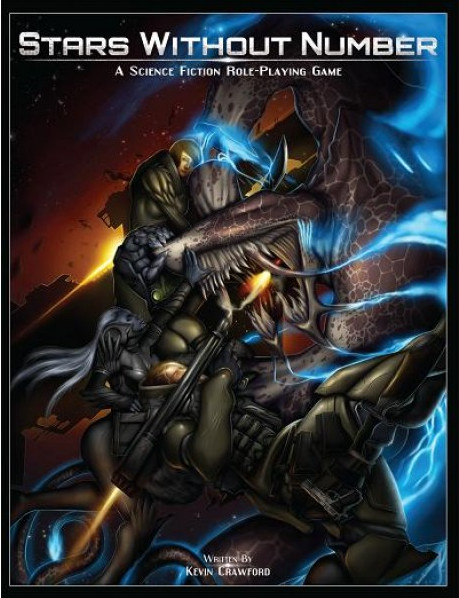
The free edition has a cover that is just a
starfield, but a) all available images are tiny,
and b) with enough time you could count the
stars, making the title inaccurate.
This is a tough one to answer, because I'm not really clued into the sort of gaming networks that would point me to promising free games, and because there are so many of them I don't tend to grab them without that guidance. Time is as limited a resource for me as money. 

The free game I've had most fun with Stars Without Number, but actually while I had the free version, the full game was also sold commercially. SWN is part of the Old School Renaissance, based on the rules of early versions of D&D and their contemporaries, with at least three different resolution mechanics (roll high on d20 attack rolls, roll low on d20 saving throws and roll high on 3d6 + modifier skill rolls,) 3-18 attributes converting to -3 to +3 modifiers and class-based progression, set in a sprawling space opera universe where the once mighty domain of the Mandate has been shattered by the catastrophic loss of much of their technology and infrastructure in an enigmatic event called the Scream. It's a lot of fun, but of course in part that's down to the GM. 

I also had a lot of fun with a one off called Lady Blackbird, which is presented as a free introductory scenario and quick-play rules for a larger game that doesn't exist. The creators, One Seven Design, do a lot of these, and while their replay value is limited, they all look pretty interesting.

-

I was going to talk about the OSR in my expanded section of this post, but honestly I know jack about the OSR and other people have already discussed it much better. Besides, I'm now four days behind, having skipped the weekend for gaming away from computers and internets, so let's move on.

Thursday, 6 August 2015

#RPGaDay 2015: Day 6 - Core competences

Prompt: Most recent RPG played

Like Feng Shui before it, Fate Core rocks the
appeal of combining gunplay, swordplay, magic and
cyborg apes.
The most recent game I've played is my by-Skype Fate Core game, Operatives of CROSSBOW. If this were the prompt for Monday it would be No Rest for the Wicked. So it goes. I talked about Fate Core a fair bit last year, I think, but what I love most about it is its flexibility. It's designed as a moderately universal system, and it is in terms of content. You can run pretty much any sort of story under Fate Core, which is not to say that it is the only game you'll ever need. It only has one style of play; as crunchy as you might make the skill set, it is fundamentally a collaborative narrativist game and will never be hardcore simulationist or competitive.

The content customisation is vast, however. Permanent and transitory qualities of people, objects and places are described by Aspects, the abilities of animate beings by Skills and special abilities by Stunts. Anything else can be tacked on. I created three magic systems for CROSSBOW in about an hour, although I'd spend longer if they were a major part of the game or if how they worked mattered.

The next game I have planned will likely also run in Fate Core, because I like being able to stat an NPC in seconds and because an 80s action TV inspired game isn't right for Gumshoe.

-

So, my broader discussion is on adaptability.

Generally, the simpler a system, the easier it is to adapt. Fate Core is designed for it, and keeps things nice and simple. Skills are trained abilities and give a flat bonus for rolls based on that skill. Aspects define intrinsic properties and can be invoked by spending Fate points or by Creating an Advantage, an action which either creates or exploits an existing Aspect and usually gives free invokes. Stunts either provide a narrow +2 bonus or some means of bending the rules in a specific situation. Stunts can easily be expanded to provide systems of magic and superpowers, and Aspects to include a heroic origin or mystical nature. Skills are tailored to setting.

Power systems are always the most complicated, often requiring substantial front loading (see for example the Dresden Files RPG,) and the one restriction I would tend to go with in any similar game having played The Dresden Files is 'all wizards or no wizards'. They're just too much more complicated, and while an all-wizard group would all know the rules pretty well (we hope) the players of a vampire, a sea monster and a faerie have no cause to learn those rules and you can end up with the wizard's player and GM spending a lot of time referring to the book (seriously, they're complex as hell, and I played Ascension.) I guess you could be more flexible once you were comfortable with the system, but not at first.

Unisystem Lite was my old go-to for conversion, but again it requires a lot of front-loading. My Stargate and Star Wars ports each had a few bits of description and a crap tonne of Qualities and Drawbacks. Still, it worked pretty well. Gumshoe would almost certainly port easily to pretty much any investigative setting, again with a bit of front loading on career profiles.

D20 on the other hand, basically needs a core book to use. You could work from just the basics, but creating and balancing classes is hard to do and pretty much impossible on the fly, and just look how many professionally produced licensed games screwed it up. This is because D20 is complicated. Its simplest iteration is D20 Call of Cthulhu, best described as an interesting experiment, which pares the system to the bones (its classes are 'offence' and 'defence' and are only very slightly different.) D20 works pretty well for a game with a zero to hero ethos, where PCs start off weak and become mighty, facing appropriate enemies all the way up.

Similarly, anything gritty and simulationist is likely to be rules heavy and thus hard to adapt, even though it should be pretty straightforward since its job is to be a simulation engine and thus relatively free of fiddling narrative conventions. The problem is that each setting then requires fixed rules for anything specific to that setting, which are often difficult to develop on the fly.

Ironically, the worst system to approach for adaptation is something like GURPS, which was to all appearances designed to be a universal, largely simulationist game engine and then incorporated a massive corpus of specific exceptions, including rules for simulating narrative conventions such as Anime Hammerspace.

Wednesday, 5 August 2015

#RPGaDay 2015: Day 5 - ...if they're really out to get you

Prompt: Most recent RPG purchase

Happiness is mandatory. Are you happy?
My most recent RPG purchase is Paranoia, the latest edition of the classic game of Kafkaesque farce and Orwellian pratfalls. This most recent variation was a Kickstarter, so I don't actually have the game yet, but it is the most recent I have bought.

-

So, from Paranoia, let's talk about avoiding the obvious.

Paranoia addressed this issue in its XP iteration with three play modes. Zap! was the mode usually fallen into by casual players and GMs, with clones dying left right and centre and the players spending much of their time in literally inescapable death traps and no-win situations. It's fun for an afternoon, but has very little campaign potential. Classic was the intended default, although as noted, default tended to drift easily towards Zap!, and was Paranoia as dark comedy. Straight was Paranoia played, well, straight, as a genuinely dark and moody dystopian setting, with any humour treacle-black.

And most games have an obvious implementation, either stylistically or narratively. D&D and D20 games in general lend themselves to combat (although see James Holloway's Day 4 video,) simply by virtue of having more rules for combat than for anything else. In fact, most games tend towards an action-focus, but this is not to say that they can not be anything other. Especially in later editions, it is perfectly possible to play D&D and broker peace between the goblins and the humans, or to seek a flower by stealth from the heart of a sacred wood, spilling no blood therein.  The key to such a narrative - and the reason you couldn't easily use both of the preceding - lies in defying expectations; in shaking up the PCs and players to see what happens. You change the story and you force the players to act differently, reexamining their goals and priorities and hopefully finding almost a whole new game in the process.

Tuesday, 4 August 2015

#RPGaDay 2015: Day 4 - Zool motherfucker, Zool!!!

Prompt: Most surprising game

Right; it's a steampunk game set in 19th Century Bavaria with airships and castles and Ludwig II and faeries and magic and Phineas Fogg and Sherlock Holmes and at the same time Conan Doyle and Jules Verne and Wells and all that good shit. Oh hells yeah! Sign me the fuck up!

Castle Falkenstein surprised me; and... not in a good way. It had my name all over it and yet it was just bad.

I think the real killer was the presentation; more than half of the book was fluff fiction about the adventures of some dude who was translated from the real world to the world of Castle Falkenstein and had paradigm-shaping adventures there. Adventures that you can't have, because he's already had them. Sure, you could back hack it, but the assumed setting of the game is that John Carter of Falkenstein has already done loads of cool shit that established the world as it stands and pretty much married the action princess to boot. This also means that the game constantly hangs a lampshade on the fact that authors and their creations exist side-by-side.

To add insult to injury, the game rules are also presented from the perspective of our wanderer in the dimensions, as a pastime he's invented to amuse his friends in between bout of heroism, so in a way the conceit of the game is not that you are playing steampunk adventurers in a magical realm of airships and faeries, but rather a bunch of bored aristocrats in a magical realm of airships and faeries who are in turn playing actual adventurers.

The game itself isn't bad, I just never escaped the image of this smug, imaginary tosser inviting me to pretend I'm as cool as he is.

-

So, my broader topic is expectation and disappointment, and how they can completely hammer a game for you. I expected big things of Falkenstein, and of 7th Sea, and it hurt my enjoyment that those expectations weren't met. Falkenstein got so caught up in its unnecessary crossworlds conceit that it completely failed to grip me. If I'm playing a game, I know it's not real, but if said game goes out of its way to add an extra layer of unreality, what's the point? It's as if the World of Warcraft RPG was presented as if simulating a group of gamers playing a MMORPG on their computers.
All of the books have '1668' written at the
bottom, which suggested a historical setting to
me. Mind you, let's take a moment to deal with
that armour. If this were on the core book, I'd
have felt myself forewarned.

In 7th Sea it was the failure of the game to be about the kind of things that interested me in the potential setting. The anachronistic stew of stereotypes (sinister Italians, brutish Irish, stoic Germans etc) wasn't much help, but ultimately it was the existence of a pervasive magic system that really nettled me. Magic feels to me like the antithesis of swashbuckling, which is all about physical refinement and discipline, cunning plans and daring escapes. Magic is more calculating and cerebral. If it is present in swashbuckling it should be in the background, a mysterious force, like fate, against which the heroes struggle to emerge triumphant. It shouldn't be routine, nor a force that the heroes can easily wield.

I don't know if 7th Sea is a good game, because I couldn't get past my initial disappointment. I hear good things, but mostly from people who clearly want something very different from what I want from a swashbuckling game. My ex raved about a campaign in which her PC spent almost all of her time as a cat, which does not feel like swashbuckling to me. A cat can't even carry a buckler (you know, unless you're playing Redwall the RPG.)

And then there was Mage the Awakening. People sometimes talk about games in terms of relationships, well Awakening was my ill-advised rebound game. I could never quite forgive it for not being its predecessor, Mage the Ascension, while still reminding me of it.

In summary: Never expect.